
Introduction
Long Term Evolution (LTE) remains the backbone of mobile connectivity for billions of devices worldwide, even as 5G rollout accelerates. For engineers working with mobile networks, IoT devices, or telecom security, understanding how LTE actually routes traffic from a handset to the internet – and where that architecture is vulnerable – is essential. This article walks through the core network architecture, the connection establishment flow, and the most significant known security weaknesses in LTE.
LTE Network Architecture Overview
LTE’s network is split into main domains: the radio access network (E-UTRAN) and the core network (Evolved Packet Core, or EPC).
- UE (User Equipment) – the smartphone or IoT device
- eNodeB – the base station, handling radio transmission and some Layer 2/3 functions
- MME (Mobility Management Entity) – handles signaling, authentication, and mobility
- SGW (Serving Gateway) – routes and forwards user data packets
- PGW (PDN Gateway) – the exit point to external networks (the internet)
- HSS (Home Subscriber Server) – stores subscriber identity and authentication data

Two separation planes run across this architecture:
- Control plane – signaling for authentication, mobility, and session setup (UE→eNodeB→MME→HSS)
- User plane – actual data traffic (UE→eNodeB→SGW→PGW→Internet)
This separation matters for security: control-plane and user-plane traffic have different protection mechanisms, and weaknesses in one don’t necessarily compromise the other – though, as we’ll see, both have known issues.
How a Device Connects: The Attach Procedure
Before a UE can send a single packet to the internet, it must complete the Attach Procedure, which combines identity resolution, mutual authentication, and bearer setup.
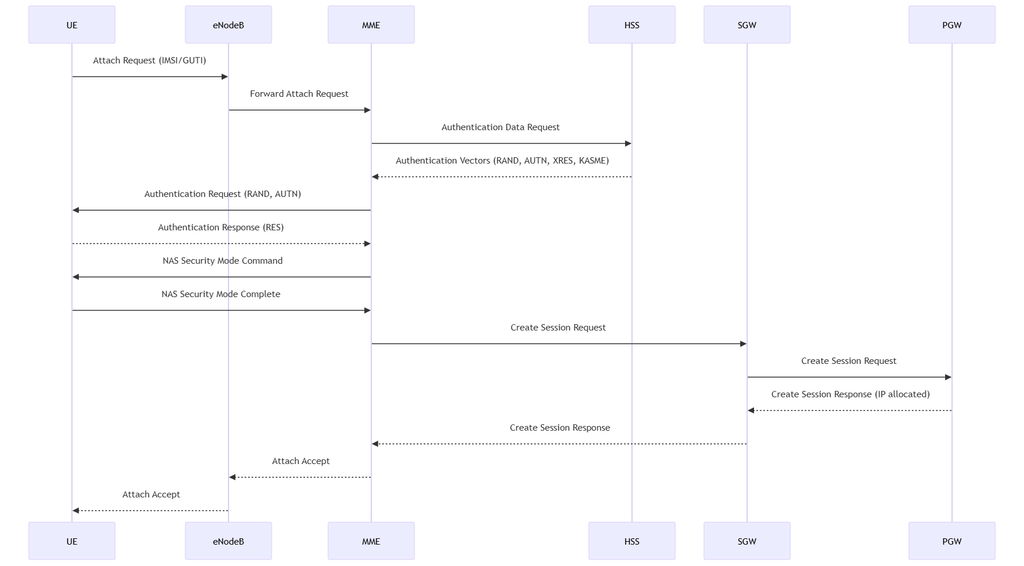
Key steps:
- Identification – the UE sends its IMSI (or a temporary GUTI, if previously assigned) to avoid transmitting the permanent identiy repeatedly.
- Mutual authentication (EPS-AKA) – the MME retrieves authentication vectors from the HSS and challenges the UE. The UE proves it holds the correct secret key, and the network proves its legitmacy to the UE via the AUTH token.
- NAS security setup – encryption (EEA) and integrity protection (EIA) algorithms are negotiated for signaling messages.
- Bearer establishment – the SGW and PGW create a default EPS bearer, and the PGW assignes an IP address, GTP tunnels are set up end-to-end for user data.
Once this completes, user data flows through GTP-U (GPRS Tunneling Protocol – User plane) tunnels: UE→eNodeB→SGW→PGW→Internet, with each hop encapsulating and forwarding packets through the established tunnnel.
LTE Security Mechanisms
LTE’s design includes several protections:
- EPS-AKA for mutual authentication between UE and network
- NAS and AS (Access Stratum) encryption/integrity using EEA (EPS Encryption Algorithm) and EIA (EPS Integrity Algorithm) – typically SNOW 3G, AES, or ZUC-based
- Temporary identifiers (GUTI) to reduce IMSI exposure over the air
- Key hierarchy – a derivers key chain (K→CK/IK→KASME→KeNB→NAS/AS keys) limits the blast radius if any single key is compromised
Known Vulnerabilities
Despite these mechanisms, LTE has several well-documented weaknesses:
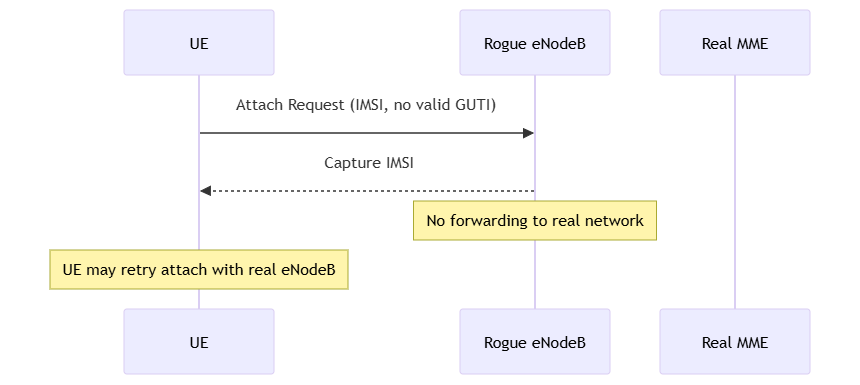
- IMSI exposure during initial attach – When a UE has no valid GUTI (e.g., first connection, or after certain resets), it must send its permanent IMSI in plaintext. This is the basis for IMSI catcher attacks, where a rogue base station impersonates a legitimate eNodeB to harvest subscriber identities.
- No mutual authentication at the radio layer before attach – the UE cannot fully verify the eNodeB’s legitmacy before initial signaling, enabling fake base station attackes that can also perform downgrade attacks (forcing a UE onto 2G/3G, where crypto is weaker).
- SS7 and Diameter signaling vulnerabilities – used for inter-carrier signaling and roaming, these protocols were designed assuming a closed trusted network. Interconnect access can allow location tracking, call/SMS interception, or subscriber profile manipulation.
- Optional integrity protection on the user plane – unlike the control plane, LTE user-plane data is typically encrypted but not integrity-protected by default, which opens the door to certain packet injection or manipulation attackes (as demonstrated by research such as the aLTEr attack).
- Bidding-down and null-cipher attacks – implementation flaws in some networks/devices have allowed attackers to force weak or no encryption for a session.
LTE vs. 5G: A Brief Note
5G addresses several of LTE’s weaknesses at the architecture level. The SUPI (Subscription Permanent Identifier) is never sent in the clear – it’s concealed as a SUCI (Subscription Concealed Identifer) using public-key encryption, closing the plaintext-IMSI gap that enables IMSI catchers. 5G Standalone (SA) also mandates user-plane integrity protection and introduces a more robust security architecture (SEAF, AUSF) for authentication. That said, many 5G deployments today run in Non-Standalone (NSA) mode, whcih still releis on the LTE core – meaning LTE’s legacy vulnerabilities remain relevant for the foreseeable future.
Conclusion
LTE’s architecture elegantly separates radio access, mobility management, and packet routing, using a well-defined authentication and key hierarchy to protect subscribers. But design trade-offs – particulary around initial identity exposure and optional user-plane integrity – leave real, exploitable gaps that have been demonstrated in both academic research and real-world attacks. For engineers building or securing systems on LTE, understanding this attach flow and its weak points isn’t just academic – it directly informs decisions like SIM provisioning, roaming security, and IoT device hardening.







コメント